Mansion Tax Proposal
That Will Make It More Expensive for New Yorkers to Own Anything
New York State's Senate and Assembly have each released One-House budget proposals that include a significant expansion of the mansion tax — the one-time transfer tax paid by buyers at closing on residential purchases. If passed in its current form, the new rates would take effect June 1, 2026, and would apply to transactions that didn't previously trigger the tax at all.
The framing, as always, is that this targets luxury. The reality is more complicated — and considerably more damaging to the buyers the city claims to be protecting.
What's changing
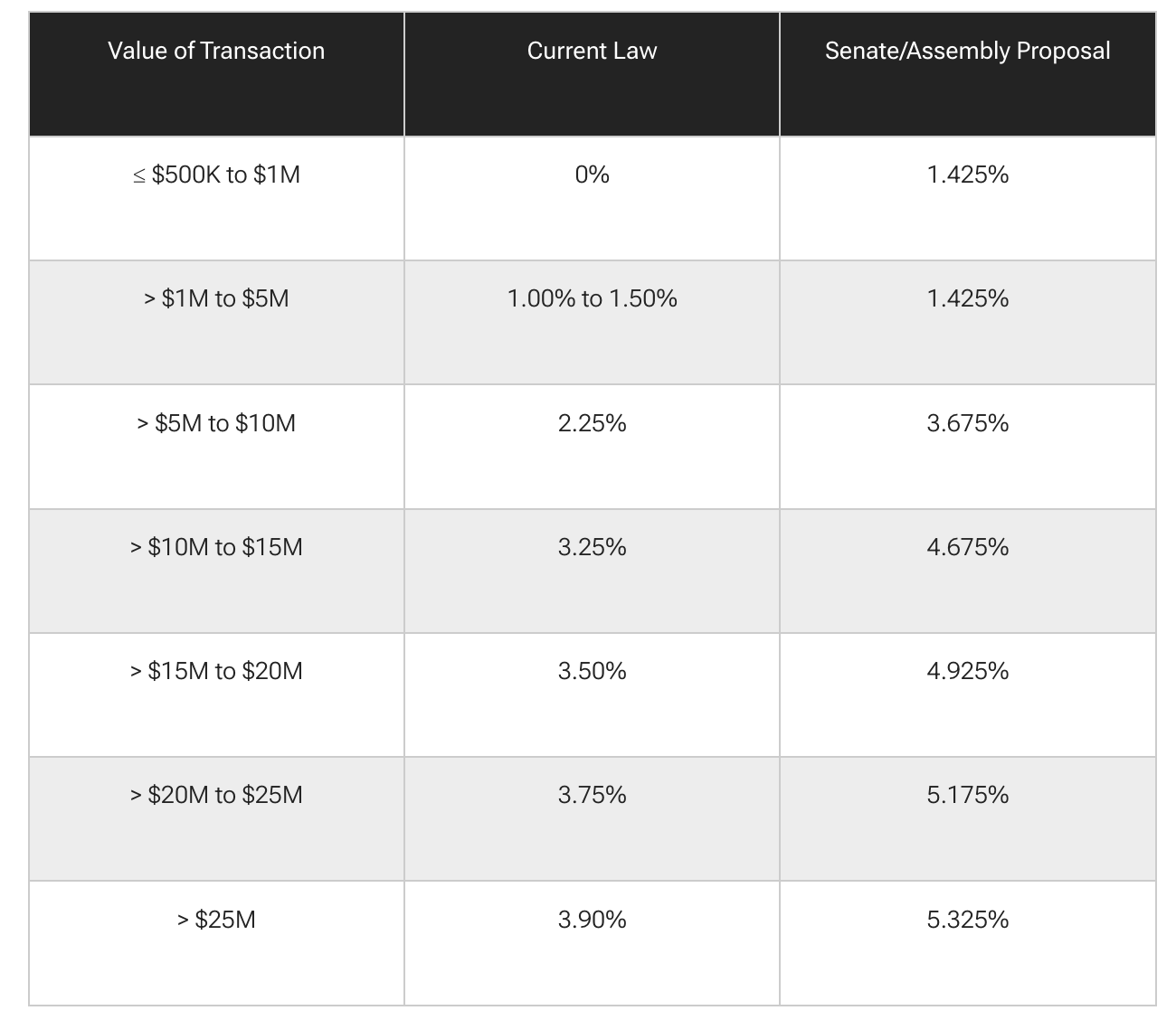
The rate increases are substantial across every tier.
Under current law, the mansion tax begins at 1% on purchases of $1 million or more, with rates scaling upward at higher price points. The proposed changes increase rates across the board — and, significantly, introduce a new 1.425% tax on transactions between $500,000 and $1 million that currently carry no tax at all.
On a $5 million purchase, the rate jump from 1.50% to 1.425% is actually a marginal decrease — but cross into the $5M–$10M tier and the picture changes sharply. On a $7.5 million purchase, the rate climbs from 2.25% to 3.675%, adding roughly $105,000 in tax. On a $10 million purchase, that same jump costs the buyer an additional $142,500 at the closing table. These are real numbers with real consequences for how deals get structured, priced, and — in some cases — whether they happen at all.
The real impact
This isn't just a luxury problem. It starts at $500,000.
In New York City, $500,000 does not buy a luxury apartment. In most of Manhattan, it barely buys a studio. The decision to extend the mansion tax downward into the sub-$1M range — a bracket that previously carried no transfer tax burden for buyers — is where this proposal stops being a wealth tax and starts being something else entirely.
The buyers in that range are not hedge fund managers and gallerists. They are people who have spent years saving to make a first purchase. People who are currently paying rent every month to a landlord, building no equity, with no stake in the city they live in — and who are trying, for the first time, to change that. Adding a new 1.425% tax on their closing costs doesn't make homeownership more accessible. It pushes the door further closed.
Every dollar added to closing costs is a dollar that has to come from somewhere, and for first-time buyers, it usually means the difference between being ready and not being ready.
Mayor Mamdani campaigned on making New York more affordable. This does the opposite.
Mayor Mamdani's platform was built in significant part on the promise of reducing the cost of living for everyday New Yorkers — making housing more accessible, reducing the financial pressure on renters, creating more pathways to ownership for working and middle-class residents. These are not small promises. They were central to why he was elected.
It is worth asking, then, how a policy that adds new tax costs to the lowest tier of residential purchases advances any of that. The argument that higher closing taxes on buyers translate into more affordable housing has no logical foundation. Sellers don't absorb these costs out of goodwill — they factor them into negotiations, or buyers simply transact less. Less transaction volume means less market activity, less revenue flowing into the city from related taxes, and a housing market that becomes progressively harder to enter at every level.
The people who can absorb higher closing costs are the ones with more capital. The people who can't are the ones the administration says it's trying to help.
Where things stand
This is not law yet. But it has momentum.
One-House budget proposals represent each chamber's priorities heading into final negotiations with the Governor. The fact that both the Senate and the Assembly have included these rate increases is meaningful — it signals alignment between chambers that makes the proposal harder to strip out in final budget negotiations.
Nothing is final until the Governor signs a budget. But anyone with a transaction in progress — or actively considering one — should be paying attention to the June 1, 2026 effective date. Deals that close before that date are subject to current rates. The gap between current and proposed rates is wide enough that timing, in many cases, becomes a material financial decision.
If you're in a transaction or considering one, the clock matters.
If you have a deal in progress — talk to your broker and attorney about whether accelerating your closing timeline before June 1 is feasible given where you are in the process.
If you're actively searching — factor the proposed rates into your total cost modeling now, even before the budget is finalized. Planning around the worst case is the right call.
If you want to push back — contact your State Senator, Assembly Member, and the Governor's office directly. REBNY and other industry organizations are actively mobilizing. Individual voices matter before a budget is signed, not after.
The bottom line
Taxing buyers more doesn't make housing affordable. It makes it scarcer.
New York's housing market is already one of the most expensive and structurally complex in the world. The friction of entering it — closing costs, board approvals, legal fees, financing hurdles — is already substantial. Adding to that friction, particularly at the entry level, compounds a problem the city has been failing to solve for years.
If Albany's goal is genuinely to make homeownership more achievable for more New Yorkers, the policy direction here runs directly counter to that. The people who most need the door to stay open are the ones who will feel this most. That should be part of the conversation.
AKN advises buyers on architecturally distinctive properties in downtown Manhattan. This piece reflects our read of the current legislative landscape and is not legal or tax advice. For specific guidance on how these changes may affect your transaction, consult a licensed real estate attorney.